Archives
-

A FOUNDATION TEXT IN CELL BIOLOGY
2025This Book is intended for students who wish to understand the Basic Cell Physiology in relations to Cell structures, Processes, Functions and Development. The study of Cell Biology is essential for this purpose, but it would be almost impossible for a student to survey on his own the massive body of existing knowledge, constantly augmented by a remarkable torrent of brilliant discoveries and findings by scientists. The purpose of the Book “A Foundation text in Cell Biology”, then, is to update and organize our knowledge into something that can be comprehended in a relatively short time and still convey a reasonably complete picture of the Basic Physiology, structure and functions of
living cells, tissues, organs and organs systems. A Foundation Text in Cell Biology encompasses basic cell structures and cellular functions including: Cell composition, Cell growth, Cell division, Cell cycle and Cell transport. Elaboration of Cell structure has significantly aided understanding the structure of organisms in relation to functions. The book also contains guidelines for Students' Practical Activities and Tutor Marked Assessment Questions. Therefore, it is designed not only to give instruction in Tutorial form but also to provide a ready means of Self assessment. It is intended primarily for students of Biology, Botany, Biochemistry, Developmental Biology, Agriculture, Genetics, Microbiology, and Biotechnology at higher levels of education, but it should also prove useful to foundation students of Medical and Laboratory Sciences as well as candidates for Diploma and College Examinations. The contents follow the conventional arrangement of most courses and have been divided into Fifteen Chapters for ease of reference. Chapters One and Two are essentially introductory, covering aspects of (i) Chemical Constituents of Cell and Organic Molecules; (ii) Cell Discovery, Development and Levels of Organization. While, Chapters Three to Five outline the (iii) Prokaryotic and Eukaryotic Cells, (iv) Protozoa, Algae and
Fungi Cells; and (v) Viruses: Discovery, Structure and General Properties. The focus in Chapters Six to Eight is on (vi) Ultrastructure in Eukaryotic Plant and Animal Cells; (vii) Enzyme Activities and Reactions in Cells; and (viii) The Nucleic Acids, Proteins and Storage of Genetic Information in Cells. Whereas, Chapters Nine to Twelve deliberates on (ix) Cell Cycle and Cell Division; (x) Diversity in Plant and Animal Cells; (xi) Movement of Materials across Cell; (xii) Cell Growth, Differentiation and Specialization. While Chapters Thirteen to Fifteen considers (xiii) Photosynthesis; (xiv) Respiration in Living Organisms; and (xv) Cell Microscopy, Cytological Techniques and Reporting of Laboratory experiments. Keeping the subject within bounds has involved some sacrifices. The subject is paramount, and the authors' interest is secondary. I hope the “A Foundation text in Cell Biology” serves its purpose well, but it clearly would have had much less chance of doing so without the intensive collaboration of Dr Samuel R. Osu, Dr Godwin Evans Udofia, Dr Aniefon Alphonsus Ibuot, Dr Aniefiokmkpong Okokon Okon, Dr Christiana Ofonime Edet Umoh, Dr Inemesit Ndarake Bassey, Dr Samuel Eguom Osim,Dr Joseph Etim Okon, Dr Ofonmbuk Samuel Aderi, Dr Esther Etop Ekon, Dr Nsimeneabasi Michael Udoh, Dr Emem Okon Mbong and Mayen Godwin Ben, all skilled biologists and great Teachers with the desire to share their joy upon learning new things. I commend them for their steadfastness and guts. This publication has been produced as part of the authors' long-term research plan and desire to promote the study of Cell Biology and related courses. -

PLANT ANATOMY AND HISTOLOGY
2025A book by Samuel Robert Osu (Ph.D)
CONTENTS | PAGES
Dedication | iii
Acknowledgment | iv
Foreword | v
Preface | vi
Table of Contents | vii
List of Tables | xiii
List of Figures | xiv
List of Appendices | xviCHAPTER ONE
ANATOMY AND HISTOLOGY OF HIGHER PLANTS
1.1 Plant Anatomy | 1
1.2 Plant Anatomy, Cytology and Histology | 2
1.3 Organisation of Cells in Seed Bearing Plants | 3
1.4 Relevance of Plant Histology in Higher Plants | 4
1.5 Cells and its Relationship in Higher Plants | 5
1.6 Summary | 5
1.7 Evaluation | 6
1.8 Tutorial Questions | 7
CHAPTER TWO
DIVERSITY OF CELLS: STRUCTURE AND SPECIALIZATION
2.1 General Information | 9
2.2 Diversity and Shapes of some Specialized Cells | 10
2.3 Organization of a generalised Plant Cell | 11
2.4 Description of the Cell Organelles | 14
2.4.1 Endoplasmic Recticulum | 14
2.4.2 Plastids | 15
2.4.3 Mitochondria | 16
2.4.4 Vacuoles | 16
2.4.5 Cell Sap | 17
2.4.6 Ribosomes | 18
2.4.7 The Nucleus | 18
2.4.8 The cell wall | 182.5 Summary | 22
2.6 Evaluation | 23
2.7 Tutorial Questions | 24CHAPTER THREE
ORGANISATION OF VASCULAR AND NON VASCULAR PLANTS
3.1 General Information | 26
3.2 Plant Groups | 27
3.2.1 Bryophytes: Non vascular Plants | 27
3.2.2 Pteridophytes | 29
3.2.3 Gymnosperm | 32
3.2.4 Angiosperm (Flowering Plants) | 33
3.3 Characteristics of Vascular Plant | 33
3.4 Organisation of a Vascular Plant | 34
3.4.1 Leaves | 34
3.4.2 Stems | 36
3.4.3 Roots | 36
3.5 Summary | 36
3.6 Evaluation | 37
3.7 Tutorial Questions | 38CHAPTER FOUR
PLANT GROWTH AND CELL DIVISION
4.1 General Information | 40
4.2 Growth and Basis of Growth in Plants | 41
4.2.1 Definition of Growth | 41
4.2.2 Basis of Growth in Plants | 41
4.3 Nature of Growth in plant | 43
4.4 Aspects of Growth | 44
4.4.1 Dry Weight | 44
4.4.2 Measurement of Plant Height |44
4.4.3 Region of fastest growth inPlants | 45
4.4.4 Determination of the rate of growth of a Root | 46
4.4.5 Determination of the rate of growth of a Shoot | 47
4.5 Cell Division in plants: Mitosis | 48
4.6 Importance of Mitosis | 51
4.7 Meiosis | 51
4.8 Importance of Meiosis | 56
4.9 Similarities and Differences between Mitosis and Meiosis | 56
4.9.1 Similarities | 564.9.2 Differences | 57
4.10 Summary | 57
4.11 Evaluation | 58
4.12 Tutorial Questions | 59CHAPTER FIVE
HISTOLOGY OF MERISTEMATIC AND PERMANENT TISSUES
5.1 General Information | 61
5.2 Meristematic Tissues 62|
5.3 Permanent Tissues 64
5.3.1 Simple Permanent Tissues | 64
Parenchyma | 64
Collenchyma | 65
Sclerenchyma | 65
5.3.2 Complex Permanent Tissues | 66
Xylem | 67
Phloem | 67
Epidermis | 68
Periderm | 68
5.3.3 Secretory Tissues | 69
5.4 Summary | 69
5.5 Evaluation | 70
5.6 Tutorial Questions | 71CHAPTER SIX
HISTOLOGY OF PLANT TISSUE SYSTEM AND
DISTRIBUTION OF TISSUES
6.1 General Information | 73
6.2 Plant Tissue System | 74
6.2.1 Dermal Tissue | 74
6.2.2 Vascular Tissue | 75
Xylem | 76
Phloem | 77
6.2.3 Ground Tissue | 79
6.3 Characteristic Feature, Functions and Distribution
of Plant Tissues | 79
6.4 Summary | 80
6.5 Evaluation | 81
6.6 Tutorial Questions | 82CHAPTER SEVEN
ANATOMY OF LEAVES
7.1 General Information | 84
7.2 The Leaf | 85
7.3 Part of a Dicot Leaf | 85
7.4 Part of a Monocot Leaf | 85
7.5 Simple and Compound Leaves | 86
7.6 Structure of a Leaf | 87
7.7 Mesophyll and veins | 88
7.8 Functions of Leaves | 90
7.8.1 Photosynthesis | 90
7.8.2 Transpiration | 90
7.8.3 Gaseous Exchange | 91
7.9 Healing of Wounds and Falling of Leaves | 92
7.10 Summary | 94
7.11 Evaluation | 95
7.12 Tutorial Questions | 96CHAPTER EIGHT
ANATOMY OF STEMS
8.1 General Information | 98
8.2 Structure of Stem and Function | 98
8.3 Monocot and Dicot Stem | 100
8.3.1 Monocot Stems | 100
8.3.2 Dicot Stems | 100
8.4 Primary Growth in Stems | 101
8.4.1 Primary Tissues in Dicot and Monocots Stems | 102
8.5 Secondary Growth of Stems | 103
8.5.1 Formation of the Vascular Cambium | 103
8.5.2 Formation of Wood | 104
8.5.3 Formation of Bark | 105
8.6 Anatomy of Tree Trunk | 106
8.7 Summary | 107
8.8 Evaluation | 108
8.9 Tutorial Questions | 1099.9 Evaluation 122
9.10 Tutorial Questions 123CHAPTER NINE
ANATOMY OF ROOTS
9.1 General Information 111
9.2 Types of Roots 111
9.3 The Root tip and its Growth 113
9.4 Structure of a Young Dicot Root 114
9.5 Functions of Roots 116
9.6 Primary Tissues in Dicot Root 119
9.7 Secondary Root Tissues 120
9.8 Summary 121CHAPTER TEN
MICROSCOPY
10.1 General Information 125
10.2 Light Microscope 126
10.3 Electron Microscopes 127
10.4 Use of the Compound Light Microscope 128
10.5 Identifying the Parts 128
10.6 Focusing the Microscope - Lowest Power 130
10.7 Focusing the Microscope - Highest Power 131
10.8 Rules for Effective use of Microscope 131
10.9 Total Magnification 131
10.10Field of View 132
10.11Depth of Field 133
10.12Microscope Examination: Temporary or Wet mount 133
10.13Onion Epidermal Cells 135
10.14Summary 136
10.15Evaluation 137
10.16Tutorial Questions 138CHAPTER ELEVEN
MAKING BIOLOGICAL DRAWINGS AND WRITING OF EXPERIMENTAL REPORTS
11.1 Making Biological Drawing/Illustration 139
11.2 Materials required for Successful Drawing 140
11.3 Major weaknesses of Students in Reporting Practicals
In Plants Anatomy 14011.4 Cutting of Freehand Sections 141
11.5 Writing Reports of Experiment 142
11.6 Summary 143
11.7 Evaluation 144
11.8 Tutorial Questions 145CHAPTER TWELVE
PRACTICAL EXERCISES IN PLANT ANATOMY AND HISTOLOGY
12.1 Section Cutting 146
12.2 Practical -1: Mounting 147
12.3 Practical -2: Microscope Examination 147
12.4 Practical -3: The Leaves (Dicot/Monocot) 147
12.5 Practical -4: Observation of Primary and Secondary
Thickening in Roots 148
12.6 Practical -5: Observation of Dicotyledonous Stem 148
12.7 Practical -6: Observation of Dicotyledonous Root 149
12.8 Practical -7: Sectioning and Staining Technique of Plant tissues 150
12.9 Essential Laboratory Experiments 151
12.10Evaluation 159
12.11 Tutorial Questions 160
Bibliography 161
Glossary 164
Appendices 184
Index 216 -
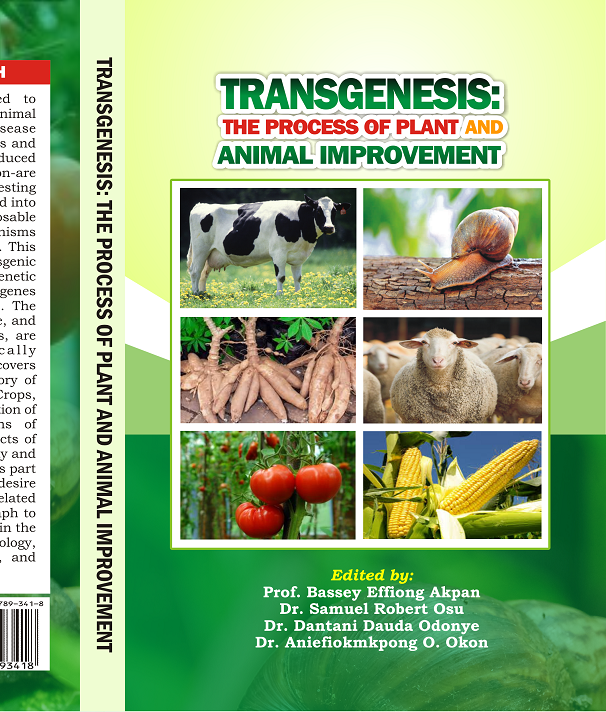
TRANSGENESIS: THE PROCESS OF PLANT AND ANIMAL IMPROVEMENT
2025Authors:
Dr Samuel Robert Osu
Dr Samuel Eguom Osim
Dr Imo Robson Udosen
Dr Owoidihe Monday Etukudo
Dr Joseph Ibanga Udo
Ekeng Ita Okon
Emem Martin EshietCONTENTS PAGES
Dedication-----iii
Acknowledgement---- iv
Foreword-----v
Preface -----vi
Table of Contents---- vii-ix
CHAPTER ONE
1.0 Introduction---- 1-3
CHAPTER TWO
2.0 History of Transgenic Organisms-4-10
2.1 Transgenic Plants---4-7
2.2 Transgenic Animals ---7-10
CHAPTER THREE
3.0 Transgenic Organisms---11-17
3.1 Genetically Modified Crops-- 11
3.2 Transgenic Plant Technology-- 12-13
3.3 Genetically Modified Animal-- 14
3.4 Transgenic Insect Technology-- 14
3.4.1 Applications of Transgenic Insects
Technology-- 15-16
3.5 Genetic Modification to Improve
Biological Control Agents-- 16-17
CHAPTER FOUR
4.0 Engineering in Plant Metabolism-18-22
4.1 Engineering of Primary Metabolic
Pathways -- 18
4.1.1 Carbohydrate Metabolism-- 18-19
4.1.2 Amino Acid Metabolisms-- 19-20
4.1.3 Polyamines Metabolisms-- 20-21
4.1.4 Lipid Metabolisms-- 21
4.2 Engineering Secondary Metabolic
Pathways-- 21-22
4.3 Engineering Novel Metabolic Pathways 22
CHAPTER FIVE
5.0 Methods for Introduction of
Transgenesis---23-33
5.1 Methods for Introduction of Transgenesis
in Plants-- 23
5.1.1 Gene guns (Biolistics)-- 23
5.1.2 Agrobacterium tumefaciens - Medicated Transfer-- 23-24
5.1.3 Electroporation-- 26
5.1.4 Microinjection-- 26
5.1.5 Clustered Regulatory Interspaced
Short Palindromic Repeat (CRISPR)-26
5.1.6 Transcription Activator - Like Effector
Nucleases (TALENS)-- 27
5.2 Methods for Introduction of Transgenesis
in Animals-- 28
5.2.1Microinjection-- 29
5.2.2Viral Transfection -- 30
5.2.3Embryonic Sterm Cells Modification-31
5.2.4Spermatocyte - Medicated Gene Transfer 31-32
5.2.5Cloning: Somatic Cell Nuclear Transfer
(SCNT)-- 32
5.2.6Transposon - Medicated Gene Silencing 32-33
CHAPTER SIX
6.0 Genetic Modification---34-40
6.1 Genetic Modification in Organisms-34-36
6.2 Types of Modifications-- 36
6.2.1 Transgenic-- 36-37
6.2.2 Cisgenic-- 37
6.2.3 Subgenic-- 37
6.2.4 Multiple Trait Integration-- 38
6.3 Types of DNA Modification-- 38
6.3.1 Insections-- 38
6.3.2Deletions-- 38
6.3.3Recombinase-- 39
6.3.4Quantification-- 39-40
CHAPTER SEVEN
7.0 Applications of Transgenic Organisms 41-46
7.1 Applications of transgenic animals-41
7.1.1Biological Research-- 41
7.1.2Xenotransplantation-- 42
7.1.3Biopharming-- 42
7.1.4Detecting Pollution-- 42
7.1.5Population Control-- 43
7.1.6Disease Control-- 44
7.2 Applications of Transgenic Plants-44
7.2.1Vitamin enrichment-- 44
7.2.2Toxin Reduction-- 44
7.2.3Stress Resistance-- 45
7.2.4Pest Resistance-- 45
7.2.5Bioremediation-- 46
CHAPTER EIGHT
8.0 Positive and Negative Effects Derived
from Transgenic Organisms-47-49
8.1 The positive effects derived from
transgenic organism-- 47-48
8.2 The negative effects derived from
transgenic organism---49
CHAPTER NINE
9.0 Future Potential, Safety and
Ethical Issues---50-55
9.1 Future Potential---50-51
9.2 Safety and Ethical Issues-- 52-54